 Free entry
Flagle
Guess the country as more of its flag is revealed.
Flags
A palette describes how much color the flag contains. Use later reveals to discover how those colors are arranged.
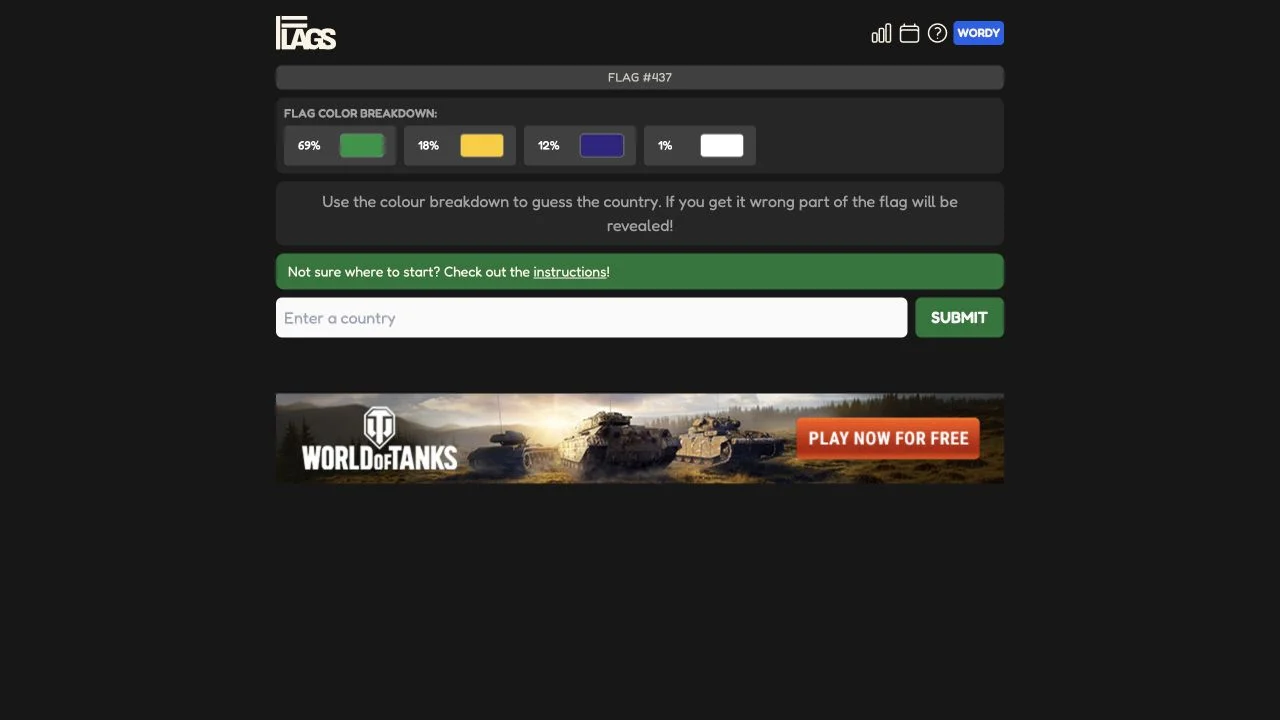
Flags Game starts with the proportions of colors in the hidden flag. The inspected puzzle showed percentages for several colors and a country-entry control. That first clue tells you how much of a color is present while hiding how those areas are arranged.
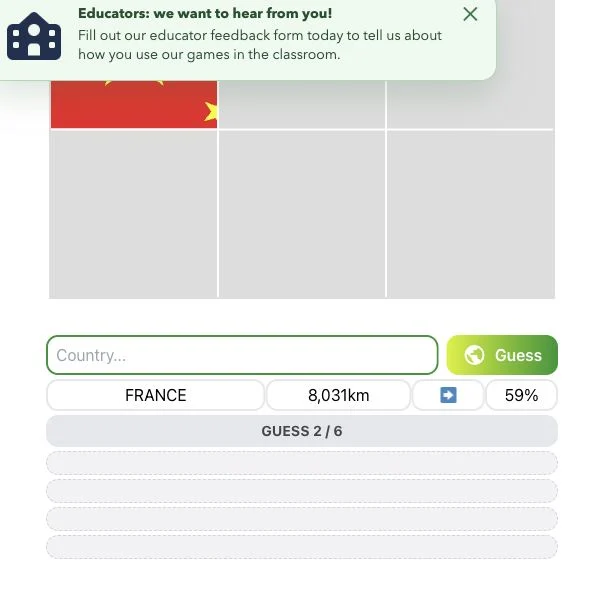
Incorrect answers add partial visual information. The task therefore moves from quantitative comparison toward ordinary flag recognition. A flag with a tiny emblem can have an extra color that barely changes the total, so treat small percentages as possible symbol clues rather than assuming they represent a full stripe.
The first clue is a distribution, not a picture. Two designs can contain the same colors in similar amounts but arrange them differently. A partial reveal helps resolve that ambiguity, while the proportions can rule out a visually tempting flag whose dominant color would occupy the wrong share.
Compare the largest area before interpreting a one-percent accent. Large proportions can reject many candidates without needing the layout.
A small percentage may belong to a coat of arms or star. Avoid forcing every color into an equally wide band.
After a reveal, keep the percentage clue in use. A plausible image fragment still needs to fit the full color distribution.
You like deduction from numeric visual clues and want the flag to emerge gradually.
You want a full-image recognition quiz. The starting percentages are deliberately indirect and need interpretation.
Choose a different game based on the experience you want.
No. They describe amounts; partial image clues add information about placement.
A small symbol or coat of arms can add a color without occupying much area. Consider those details alongside the dominant colors.