 Free entry
Flagle
Guess the country as more of its flag is revealed.
Flags
A good comparison tests a layout. Use stripe and canton positions to make each guess informative, even when the country is wrong.
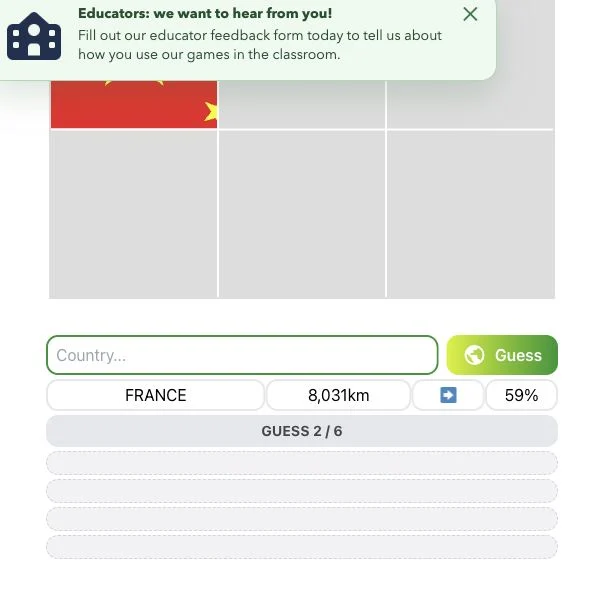
Flagle Game gives six attempts to identify a hidden flag. Its rules say that pixels shared by your guessed flag and the answer become visible after a guess. All flags are scaled to the same aspect ratio, allowing their layouts to be compared.
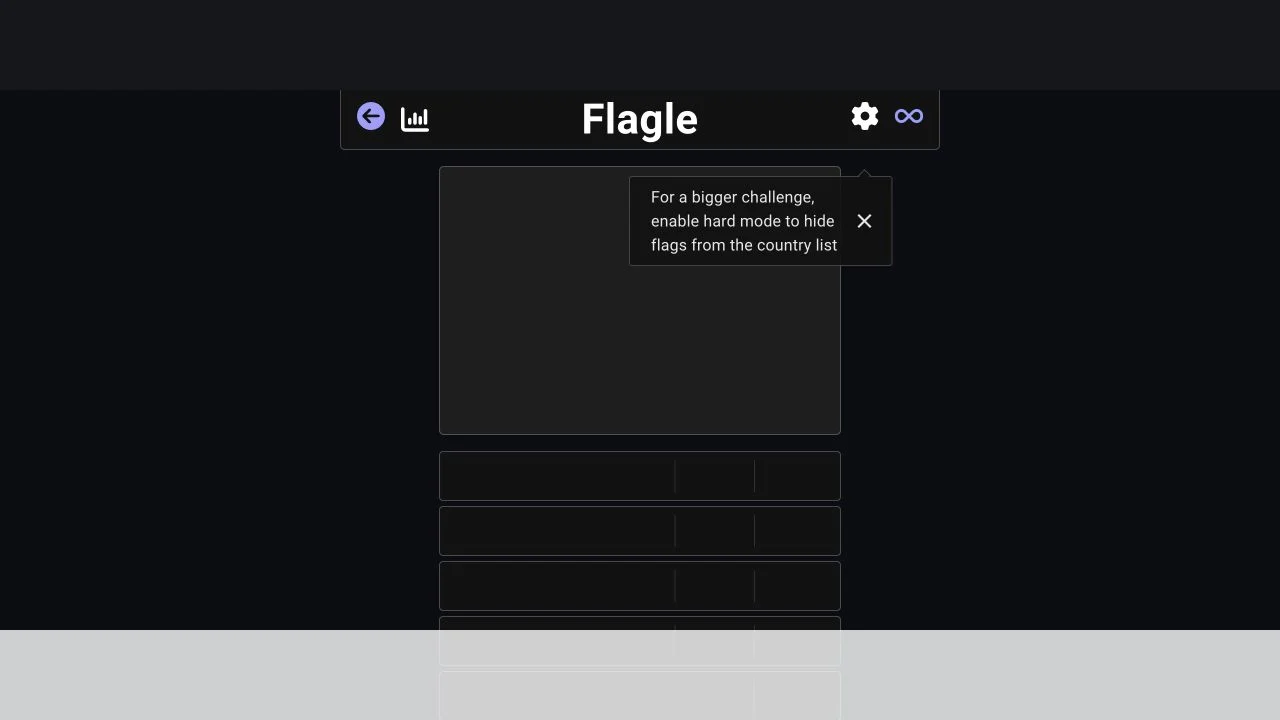
Daily and unlimited entries are linked from the site. A hard-mode tip hides flag previews in the country selector, increasing the amount you must recall unaided. This is the flagle-game.com implementation; its rules and access should not be assumed to match Flagle.io.
The revealed area depends on your chosen flag. A useful test can expose a large stripe or canton even if the country is wrong. Because flags are normalized before comparison, reason about relative positions within the displayed rectangle rather than the flag’s original physical proportions.
Choose a flag with strong bands or a canton to test a structural hypothesis. A random flag can produce matches that are harder to interpret.
A missing part of the comparison is evidence against that color in that position. Use negative feedback alongside revealed pixels.
Hiding selector previews changes the task from browsing designs to recalling them. Learn the comparison mechanic first, then add that memory constraint.
You enjoy experimental guesses whose color layout creates useful feedback, with both daily and repeat-play entries.
You want the original Flagle publisher or a simple four-choice quiz. This is a separate implementation with pixel-overlap rules.
Choose a different game based on the experience you want.
The rules state that flags are scaled to the same aspect ratio before overlap comparisons.
The visible tip says hard mode hides flags from the country list, making selection depend more on memory.