 Free entry
Worldle
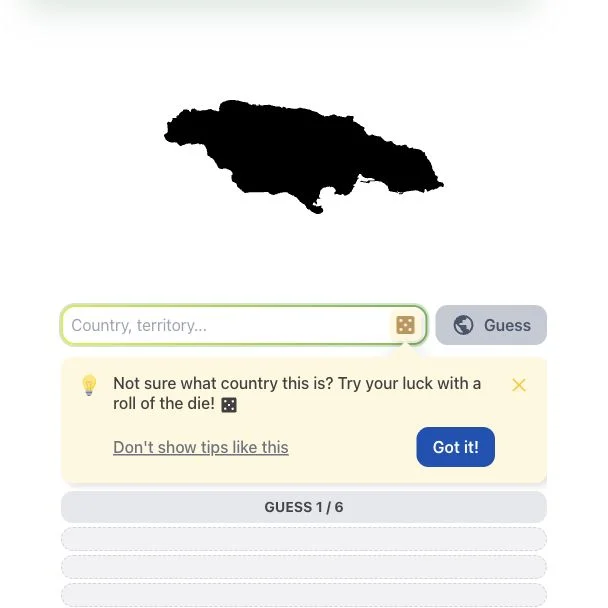
Identify a country or territory from its silhouette, using distance and direction clues.
Daily puzzles
The shape belongs to a population, not a coastline. Read the chart’s broad structure and total scale, then use geographic feedback to test which country fits.
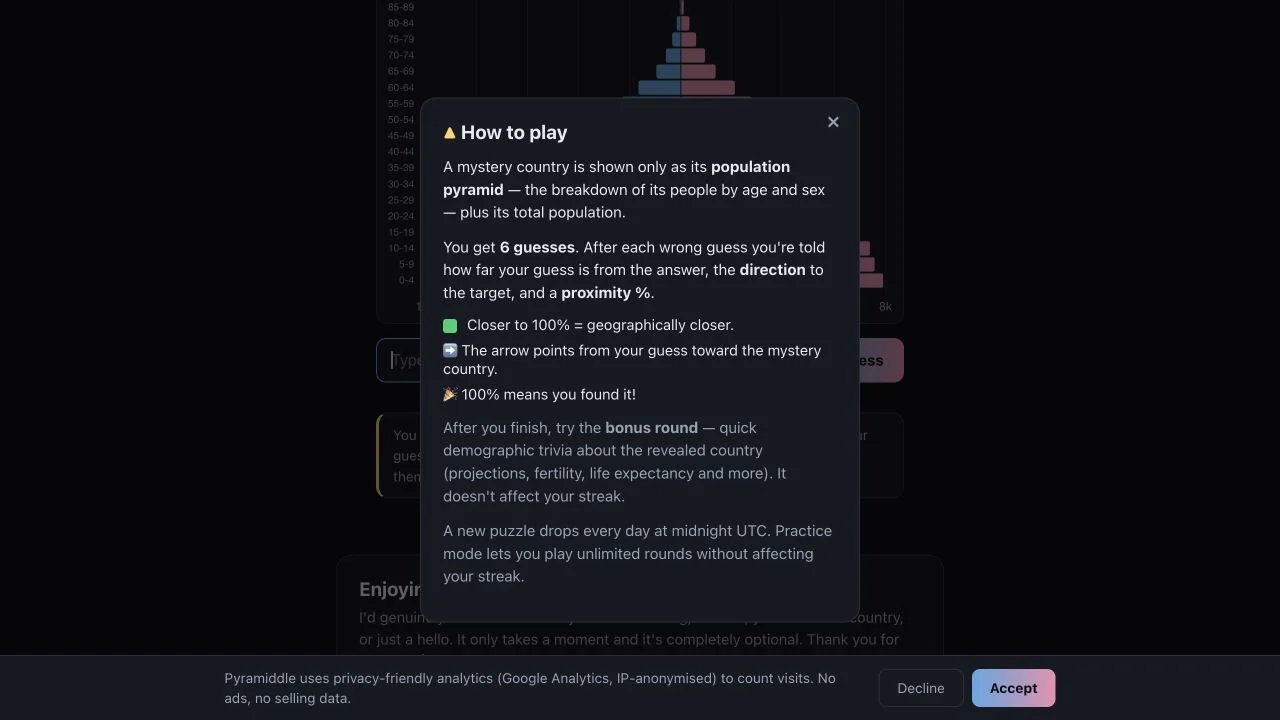
Pyramiddle shows a population pyramid rather than a national outline. Male and female bars reveal the age distribution, while a total population figure adds scale. You have six guesses, with wrong answers supplying distance, direction and proximity percentage.
The page credits UN DESA World Population Prospects 2024 and offers English, Spanish and French. A new country appears at midnight UTC for everyone. The chart is a defined population dataset, not a live census dashboard; use its age structure as evidence without turning it into a simplistic statement about a society.
A broad young base and a narrower older population suggest a different age structure from a column-like or top-heavy chart, but neither uniquely names a country. Combine the profile with total population to construct a plausible region and scale. Geographic feedback then tests that interpretation. Treat unusual bands as potential evidence of demographic history, not as proof of one event you happen to remember.
A similar pyramid shape can describe a small territory or a populous country. Use the total count before choosing among visually similar age structures.
Start with the balance of young, working-age and older groups. Small irregularities are less useful until you have a reasonable overall demographic hypothesis.
If the distance and arrow disagree with your region, revisit the chart interpretation. Avoid spending every guess defending the first demographic narrative.
You enjoy reading charts and connecting demographic patterns to geography. It adds an unusual visual entry point to a familiar country-guessing loop.
You prefer a direct map quiz or require up-to-the-minute demographic figures. The game uses a credited dataset and an interpretive chart challenge.
Choose a different game based on the experience you want.
Pyramiddle credits World Population Prospects 2024. Different dates, methods and territory definitions can produce different totals; use the puzzle’s supplied dataset for its clues.
No. Several countries can share a broad age structure. Combine the profile with the total population and the geographic clues from your guesses.