 Free entry
Worldle
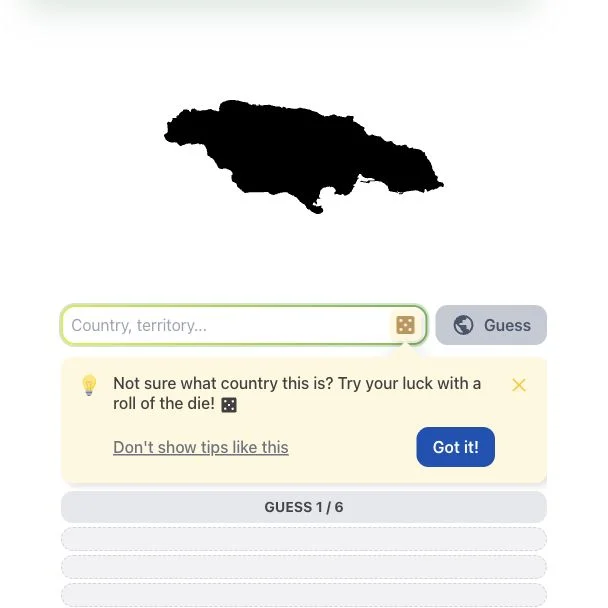
Identify a country or territory from its silhouette, using distance and direction clues.
Daily puzzles
Nine cells, two conditions per answer and a score shaped by other players’ choices. Learn when to save a flexible country, when to try a rarer one and why validity comes first.
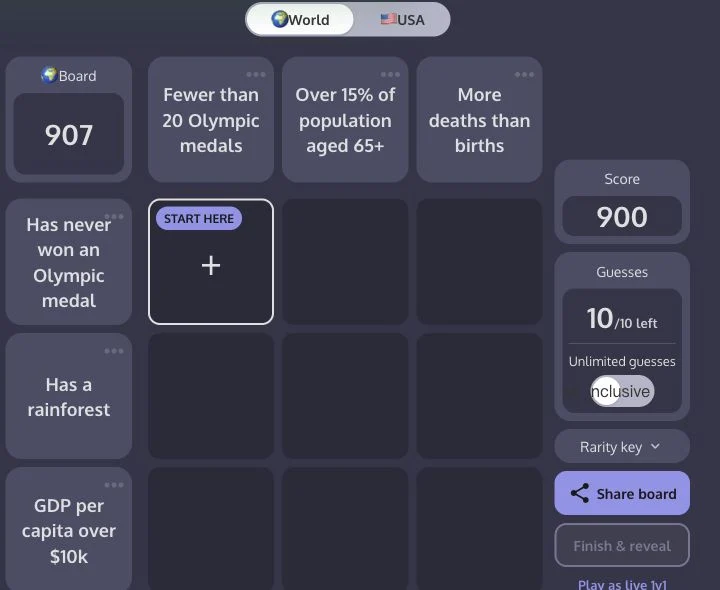
GeoGrid asks you to place countries where row and column conditions meet. A country can be a perfectly sensible answer in one cell and invalid in another, so the important skill is checking both constraints before committing.
The grid format makes a satisfying contrast to location guessing. You can use a familiar country to establish how a category is interpreted, then search your memory for less obvious countries that fit the same intersection.
The nine-cell board pairs row and column categories, and each country can be used only once on that board. The standard game gives you ten guesses, with an unlimited option available. Several countries may fit one intersection, but their scoring value differs: answers chosen less often by other players contribute a lower rarity score, and lower is better. Completing the board and finding less obvious valid answers are therefore related but different goals.
Read the row and column together before entering an answer. Asking “Which country meets both of these?” prevents you from solving one category while overlooking the other.
A country can appear only once on the board. If it fits several intersections, consider where you have fewer alternatives before spending it on the easiest cell.
Less commonly chosen valid answers lower the score, but a speculative answer can waste a limited guess. First establish why it meets both categories; rarity does not rescue an invalid answer.
You like geography trivia and want several small deductions within one daily puzzle. The grid rewards flexible recall: the same country can become useful for very different reasons in different cells.
You want visual map practice or a straightforward right-or-wrong country-location exercise. The grid can expose gaps in category knowledge without showing you where the answer sits geographically.
Choose a different game based on the experience you want.
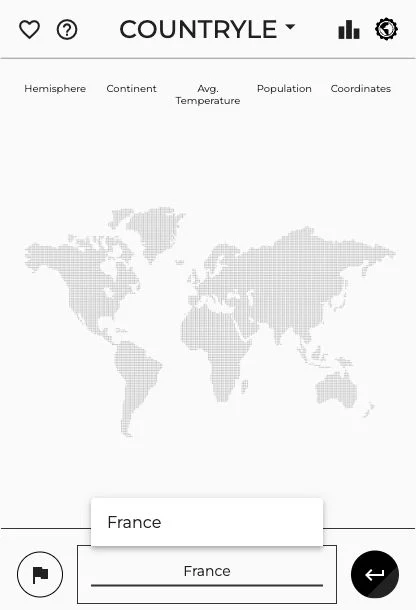
Choose Countryle to use country attributes in a single hidden-answer deduction. Its clues build toward one country rather than several row-and-column intersections.
Choose Sporcle Geography for a quiz on the specific topic that caused difficulty. A focused community quiz can help practice flags, capitals or a region outside the daily grid.
Yes, an intersection can have several accepted countries. Choose one that meets both categories and has not already been used elsewhere on the board.
Rarity reflects how often players choose an answer, not the country’s size or population. Less frequently selected valid guesses score lower; an empty cell contributes 100.