 Free entry
Worldle
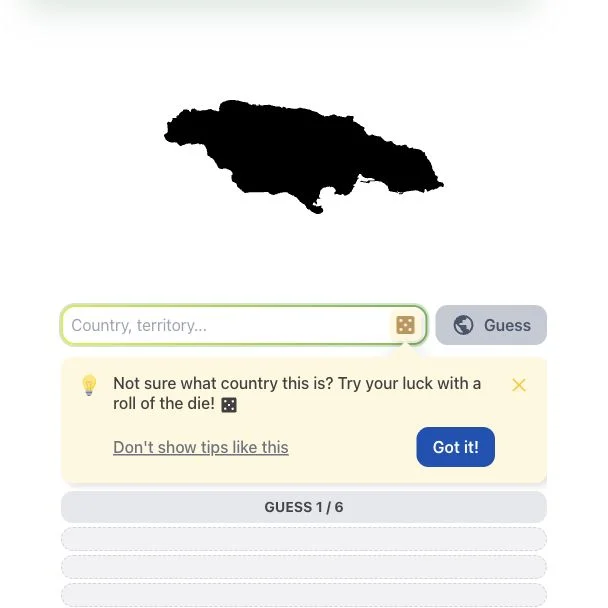
Identify a country or territory from its silhouette, using distance and direction clues.
Daily puzzles
A partial coastline can be suggestive without being decisive. Combine the region with emerging geometry and reveal another stretch only when it separates plausible country shapes.
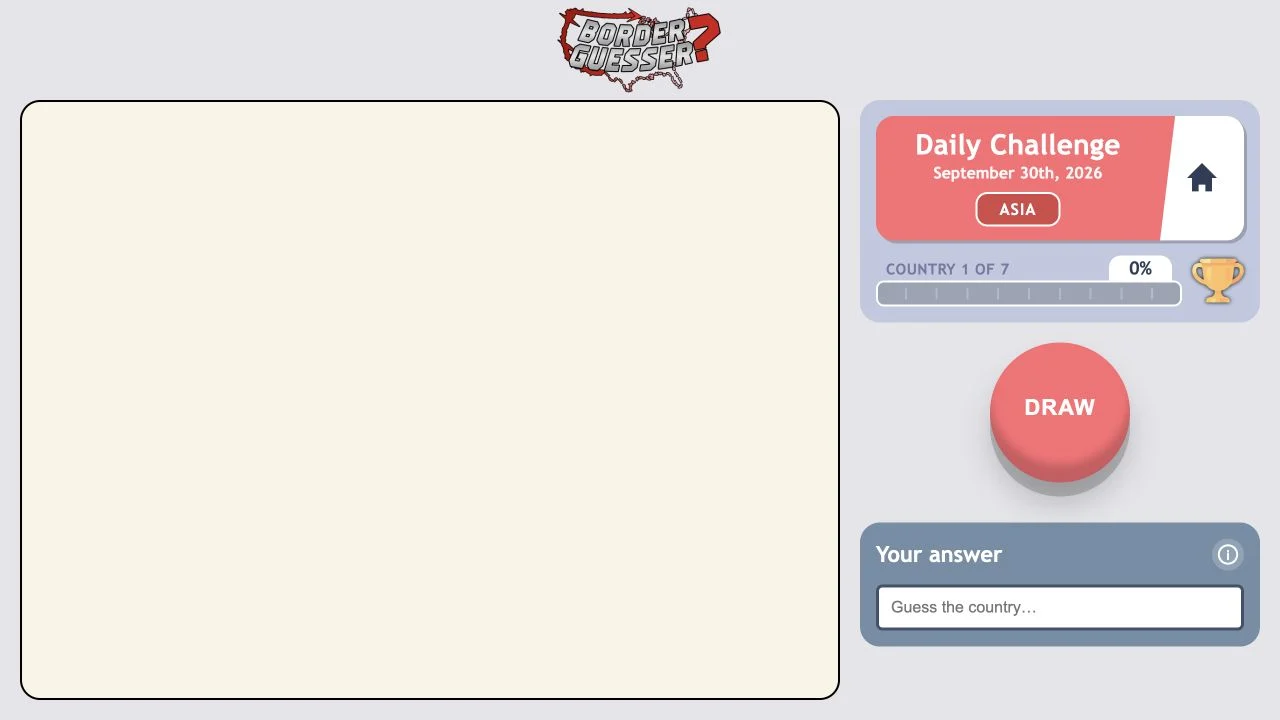
Border Guesser’s public challenge interface has a Draw control, a reveal percentage and a country-answer input. The daily format shows a sequence of seven countries. Holding Draw exposes more of the outline, changing recognition into a decision about when enough evidence is visible.
The checked current challenge displayed its date and an Asia region label. A regional clue can narrow the candidate pool while the border emerges. The directory documents the loaded entry and controls; it does not promise an exact score formula from the visible reveal percentage alone.
A partial boundary can suggest several countries. The useful decision is whether the next stretch of outline will distinguish your candidates. Look for a distinctive peninsula, neck or angle rather than equating “I recognize something” with a confident answer. Combine that fragment with the displayed region, and do not infer an exact score formula or penalty schedule from the reveal percentage alone.
Build a shortlist within the displayed region before drawing much of the outline. A fragment that resembles a country elsewhere is less useful if it contradicts that clue.
Name the visible feature—an arc, a narrow projection or a straight edge—before naming a country. That reduces the pull of the first familiar silhouette.
If two countries share the visible feature, expose the section that could distinguish them. More line is useful when it answers a particular uncertainty.
You enjoy recognizing shapes before they are complete. The seven-country sequence offers several visual deductions and decisions about when another fragment will help.
You prefer seeing the whole shape immediately or want a documented score formula before playing. The visible reveal percentage does not establish the complete scoring model.
Choose a different game based on the experience you want.
The checked interface showed a reveal percentage beside Draw. It describes how much of the outline is exposed; we did not verify a complete scoring formula from that indicator.
The checked round started at 0% with the Draw control. Hold it to begin revealing the boundary, then use the emerging geometry and region label to form a country hypothesis.