 Free entry
Worldle
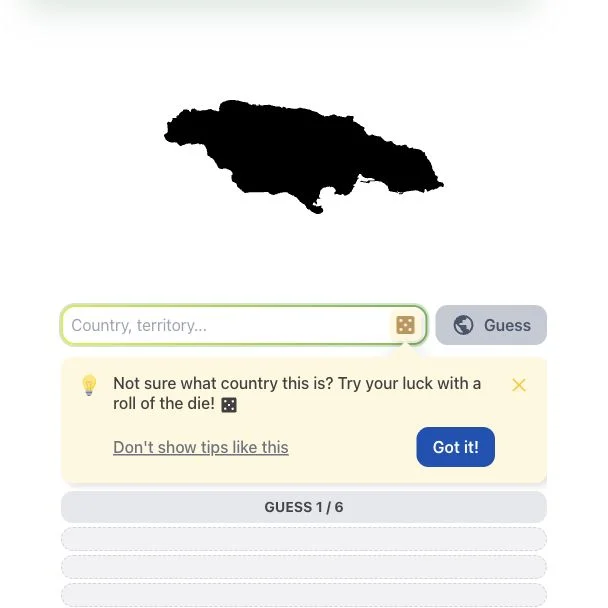
Identify a country or territory from its silhouette, using distance and direction clues.
Daily puzzles
A name can suggest a region while still leaving several borders unresolved. Look at spelling, city scale and territories as you turn an unfamiliar place into a country hypothesis.
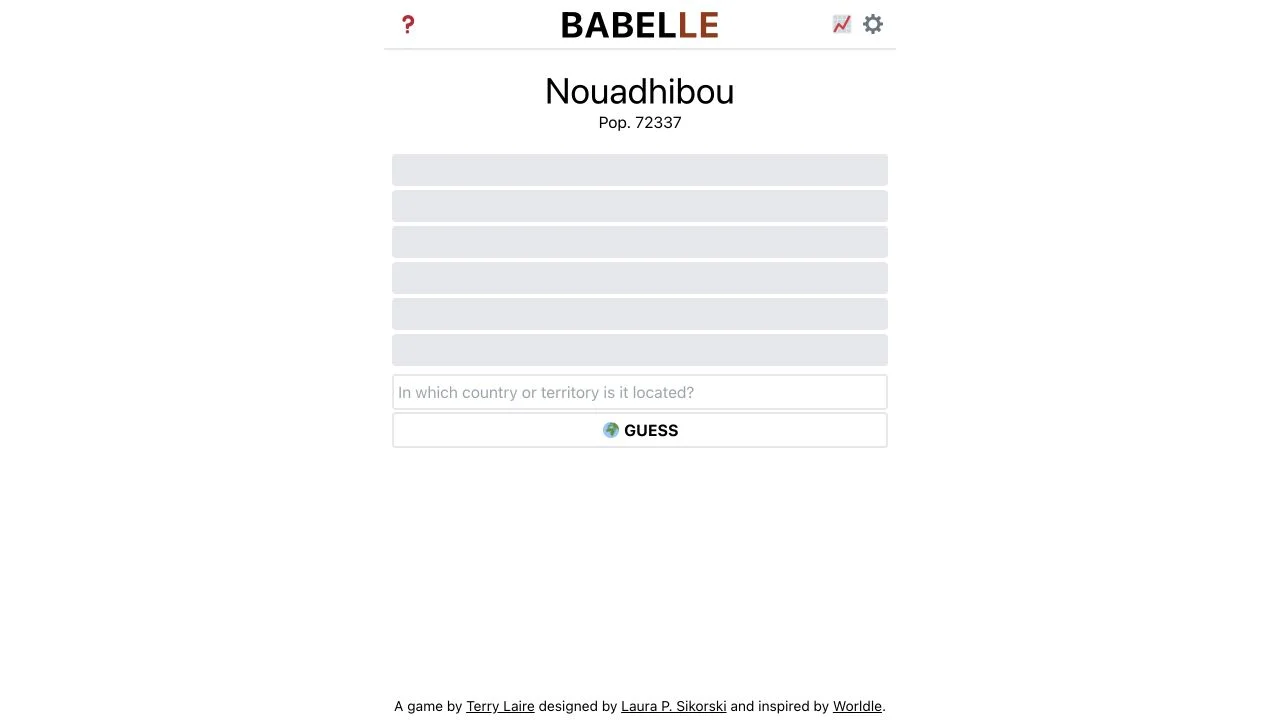
Babelle starts with a city name and a population figure, then asks which country or territory contains it. This reverses the familiar capital quiz: the place is supplied, but it may be a city you have never studied.
The public interface gives a country-or-territory input with help, settings and statistics controls. A name’s spelling can suggest a language region, but similar names and colonial naming histories complicate a quick answer. Use population as context rather than pretending it identifies the city on its own.
Toponyms can preserve several layers of history. A French-looking name may reflect administration rather than the dominant local language; an Arabic-looking name can span many countries. Form a region hypothesis, then test it against city scale and any feedback. The game rewards connecting a place name to geography, not simply recalling a familiar national capital.
An ending or transliteration pattern may be more informative than the first syllable. Avoid answering from one familiar-looking fragment.
Use the apparent language as evidence, not proof. Migration, colonial history and shared language families can spread related place names across borders.
When a plausible region contains both countries and territories, consider the full answer set. A country-only mental list can omit the intended location.
You like city names and want geography clues beyond flags and silhouettes. It is particularly suitable for exploring less familiar urban places.
You want straightforward capital recall or a map with every candidate visible. An unfamiliar city name may require inference rather than direct recognition.
Choose a different game based on the experience you want.
The checked prompt asks which country or territory contains the named city. It does not limit the task to national capitals.
Rarely with certainty. Similar language patterns cross borders, and historical naming can be misleading. Combine the name with population context and the game’s feedback.